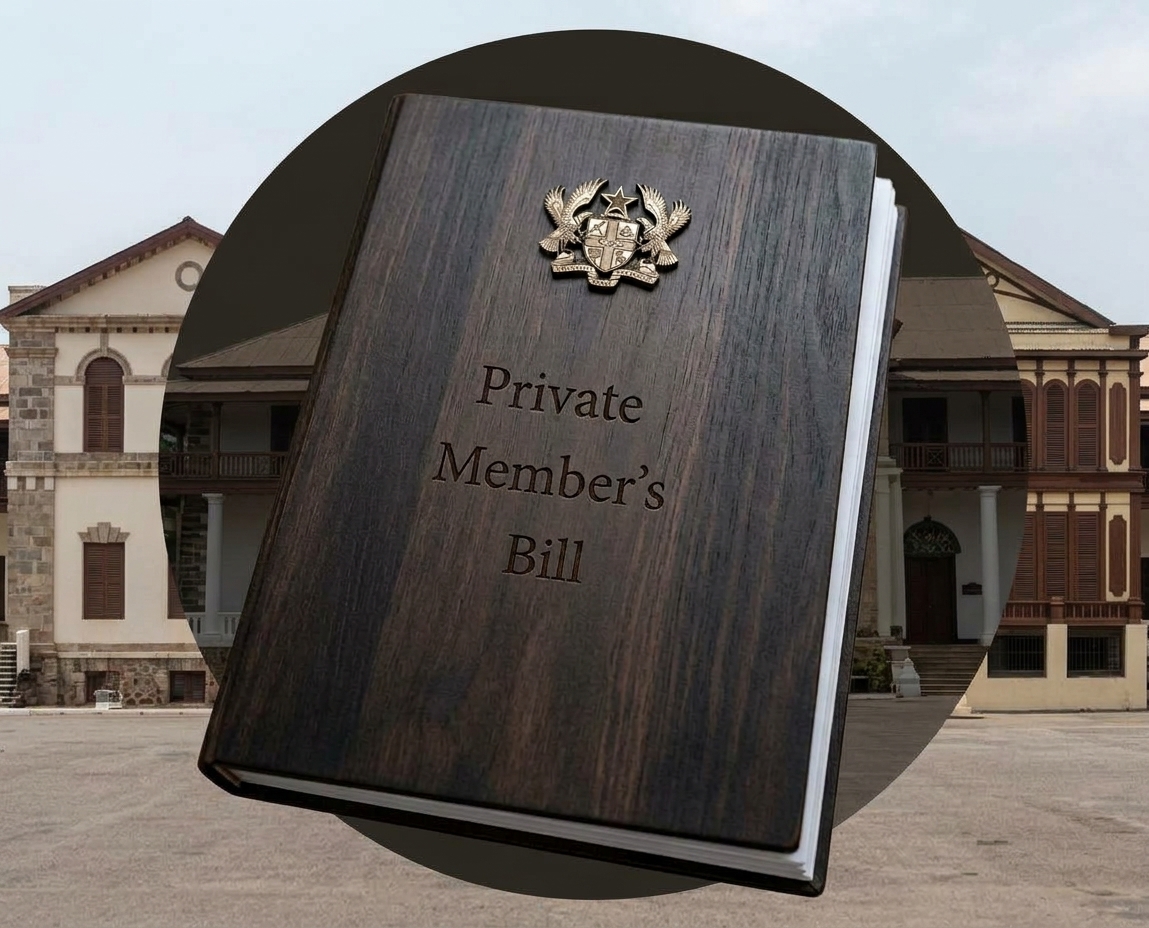
There is one real constitutional limit, and it is narrower than people think. Under Article 108, Parliament cannot proceed on a bill that imposes a tax, places a charge on the Consolidated Fund or other public funds, takes money out of those funds, or cancels a debt owed to the State, unless the bill is introduced by the President or on the President's behalf.
So the rule is not that MPs cannot make law. It is that MPs cannot make law that spends public money.
Why this matters to you
This is the difference between a Parliament that only processes what the executive sends it and one that can originate law itself. If you want a law changed, knowing that your own MP can introduce a bill - and knowing the one thing that will stop it - tells you what to ask for and what to expect.
It also matters because Article 108 has become the battleground for Ghana's most contested legislation, and the arguments made about it in public are frequently wrong in both directions.
Where the power comes from
The 1992 Constitution never uses the phrase "private member's bill". The power is drawn from the structure of the Constitution rather than from a single clause.
Article 93(2) vests the legislative power of Ghana in Parliament - not in the President, and not in the Cabinet. And Article 108 itself carries the clearest implication: by forbidding Parliament from proceeding on certain bills unless they come from the President, it takes for granted that other bills need not. A restriction on one category of bill assumes the existence of the rest.
What changed in 2020 was procedure, not the Constitution. On 16 July 2020, under Speaker Aaron Mike Oquaye, the 7th Parliament adopted a proposal for the enactment of private members' bills, and the Speaker directed the Committee on Constitutional, Legal and Parliamentary Affairs and the standing committees to report on the procedure to be used. The route had always been constitutionally available. Parliament decided to start using it.
Everything else about the process is the same as for any other bill. A private member's bill must still come with an explanatory memorandum, still be published in the Gazette at least fourteen days before introduction, still go to committee after the first reading, and still be passed and assented to before it is law - all under Article 106.
The one real limit: Article 108
Article 108 provides that Parliament shall not proceed on a bill, or on an amendment to a bill, that in its opinion makes provision for imposing or increasing a tax, for charging the Consolidated Fund or other public funds of Ghana, for taking money out of those funds other than money already charged on them, or for compounding or remitting a debt due to the Government - unless the bill is introduced by, or on behalf of, the President.
Note what it does not say. It does not say MPs may not legislate. It does not give the President a veto over ideas he dislikes. It is about money.
The genuinely difficult question is how far "money" reaches. A bill creating a new criminal offence does not contain a clause spending public funds, but enforcing it will cost the police, the courts and the prisons something. Does that count? Ghanaian lawyers disagree, and the disagreement is live.
Who decides whether a bill crosses the line
In practice the Speaker decides whether a bill may be introduced and proceeded with, and that ruling is what governs what happens on the floor.
But the Constitution does not spell out in terms who makes that call or how it is reviewed, which is part of why this area keeps ending up in court. Be cautious with anyone who states confidently that a particular bill "clearly" offends Article 108, in either direction. That is an argument, not a settled fact, until somebody with authority rules on it.
What MPs have actually used this for
Three examples show how the route works, and where it runs into Article 108.
THE DEATH PENALTY BILLS - a private member's bill that became law. In July 2023 Parliament passed bills introduced by the Madina MP, Francis-Xavier Kojo Sosu, replacing the death penalty with life imprisonment. On 2 August 2023 the President assented to the Criminal Offences (Amendment) Act, 2023 and the Armed Forces (Amendment) Act, 2023, abolishing the death penalty for ordinary offences and making Ghana the twenty-ninth African country to take it off the statute books for those offences. The death penalty remains for high treason, which sits in the Constitution and cannot be removed by an ordinary Act of Parliament.
THE WITCHCRAFT BILL - the same MP, stopped by Article 108. Sosu also introduced a bill criminalising witchcraft accusations and the practices around Ghana's witch camps. Parliament passed it. The President declined to sign, on the ground that it offends Article 108 because the costs it would create would fall on the Consolidated Fund. On 18 December 2023 the Speaker told Parliament he disagreed: "I completely disagree with him, and I gave my reasons." Sosu went on to petition ECOWAS and others to press for assent. Same MP, same route, two different outcomes - and the difference was money.
THE ANTI-LGBTQ+ BILL. Introduced as a private member's bill in 2021 and passed by Parliament in February 2024, it was not assented to. Two suits challenging it - brought by Richard Sky and by Dr Amanda Odoi - were dismissed by the Supreme Court on 18 December 2024. The bill lapsed when the 8th Parliament ended. It was reintroduced in the 9th Parliament and passed again on 29 May 2026, and is awaiting presidential assent. President John Dramani Mahama has indicated he would assent if Parliament passed it.
Why bills keep coming back
That last detail explains something readers often find baffling: why a bill that "already passed" has to pass again.
A bill that has not completed its passage when a Parliament ends does not survive into the next one. The anti-LGBTQ+ bill passed in February 2024, was never assented to, and lapsed when the 8th Parliament ended in January 2025. Starting again is not a trick and not a scandal. It is what happens when the clock runs out.
The lies this protects you from
1. "Only the government can introduce a bill"
The claim you'll see: A flat assumption that all legislation originates with the executive and that MPs merely vote on what they are given.
What's actually true: Ordinary MPs can and do introduce bills. Parliament adopted the private members' bill route on 16 July 2020, and Article 93(2) vests legislative power in Parliament. Article 108 restricts only bills that tax or spend public money.
Why it spreads: For most of the Fourth Republic it was the near-universal practice for bills to come from government, so the old habit has outlived the change in procedure.
2. "The Supreme Court ruled the anti-LGBTQ+ bill is valid"
The claim you'll see: The December 2024 judgment reported as the Court approving the bill, or as settling that it does not offend Article 108.
What's actually true: The Court dismissed the two challenges on 18 December 2024, but dismissal is not endorsement. The suits were rejected as premature, the bill not having been assented to. Views on how far Article 108 reaches appeared in separate opinions of individual justices rather than as the decision of the Court. The underlying question has not been decided.
Why it spreads: "Court rejects challenge" reads like "court approves", and a general judgment is easy to mistake for a verdict on the specific bill that prompted it.
3. "Refusing to sign a private member's bill is just a presidential veto"
The claim you'll see: Any refusal of assent described as the President vetoing a law he dislikes.
What's actually true: Ghana's President has no general veto. Refusing assent triggers the process in Article 106: reasons must go to the Speaker, Parliament reconsiders, and if it passes the bill again with the votes of at least two-thirds of all members, the President shall assent. Where Article 108 is invoked, the objection is the narrow and specific claim that the bill spends public money - a legal argument that can be contested, as the Speaker did in December 2023.
Why it spreads: "Veto" is the word everyone reaches for, imported from systems that actually have one.
4. "A bill that passed Parliament is already law"
The claim you'll see: Passage reported as enactment, often with a date on which the new law supposedly takes effect.
What's actually true: Passage is not the end. Under Article 106 a bill does not become law until it has been passed and assented to, and does not come into force until it is published in the Gazette. The witchcraft bill is the plain example: passed by Parliament in 2023, and never signed.
Why it spreads: The vote is the dramatic, reportable moment. Assent and gazetting are neither.
5. "They are passing the same bill again because the first one was struck down"
The claim you'll see: A reintroduced bill treated as proof that a court invalidated the earlier version, or that something improper happened.
What's actually true: Bills that have not completed their passage lapse when a Parliament ends. The anti-LGBTQ+ bill passed in February 2024, was never assented to, and lapsed when the 8th Parliament ended. Its re-passage on 29 May 2026 was a fresh start, not a response to any court striking it down.
Why it spreads: Repetition looks suspicious, and the rule that bills die with a Parliament is not widely known.
What you can actually do
-
Ask your own MP to introduce a bill if there is a law you want changed. That route exists and has been used.
-
When someone says a bill breaches Article 108, ask the specific question: does it impose a tax, charge public funds, withdraw money from them, or cancel a debt owed to the State? Anything else is argument.
-
Check whether the Speaker has actually ruled on a bill's status. That ruling governs the floor; commentary does not.
-
Distinguish passed, assented and gazetted. A bill is not law until the last of those.
-
Read a dismissal for what it decided. A court rejecting a challenge is not the same as a court approving a bill.
-
Follow bills through Parliament's own record - the Order Paper, the bills database and Hansard - rather than through claims about what was passed.