
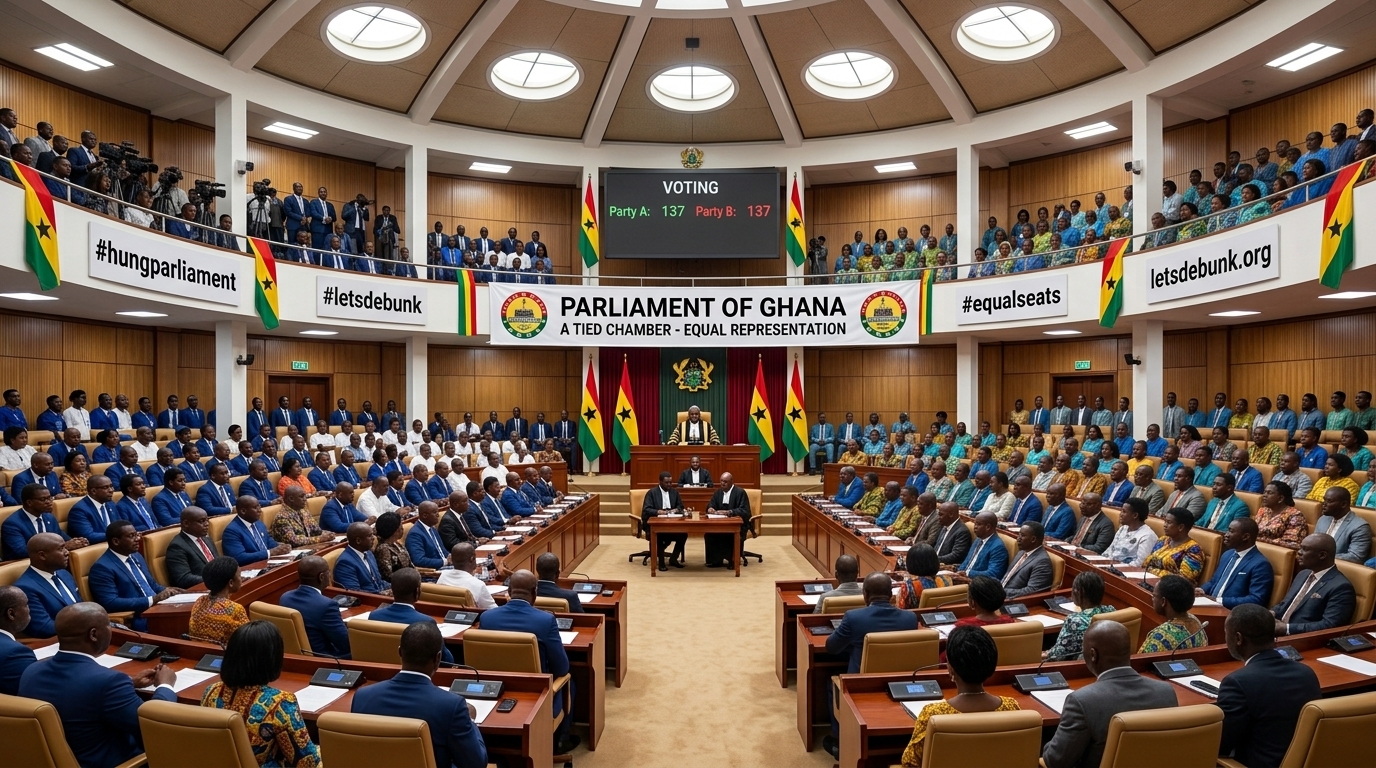
In a House like that, arithmetic becomes the story. The election of the Speaker stops being a formality, every absence matters, and a single court ruling can change who controls the chamber.
One thing to get right before anything else: Ghana's Speaker does not break ties. Article 104 of the Constitution says the Speaker "shall have neither an original nor casting vote". Where the votes are equal, the motion is simply lost.
Why this matters to you
The arithmetic in the chamber decides who chairs which committee, how quickly a budget passes, whether ministers are approved without a fight, and how much any one member is worth to the people trying to win a vote.
It also decides how much of what you hear is true. A near-even House generates more confident claims about procedure than any other situation in Ghanaian politics, and most of them are wrong in the same few ways.
Where things stand now
This section states the position as at September 2026. Ghana's Parliament is not currently hung.
The 9th Parliament was constituted on 7 January 2025 following the election of 7 December 2024. According to the Inter-Parliamentary Union's record of that election, the House has 276 seats, with the NDC holding 183, the NPP 88, and four independents. That is a clear majority, not a hung House.
So when you read about a hung Parliament in Ghana, the reference is to the 8th Parliament of 2021 to 2025 unless something has changed since this was published.
The rules that decide what a hung Parliament can do
Three provisions do most of the work, and none of them is widely known.
HOW A VOTE IS WON. Article 104(1) provides that matters in Parliament "shall be determined by the votes of the majority of members present and voting, with at least half of all the members of Parliament present". Read the second half again. It is not enough to win the votes in the room; at least half of all members must be in the room. In a House of 276 that means at least 138 members present. This is why, in a near-even Parliament, a walkout can be as powerful as a vote - and why sides sometimes argue about who was physically present rather than about the merits.
WHAT HAPPENS ON A TIE. The same article states that the Speaker "shall have neither an original nor casting vote", and that where the votes are equal the motion is lost. There is no tie-breaker in Ghana. A tie is a defeat for whoever brought the motion.
QUORUM. Article 102 sets the quorum of Parliament, apart from the person presiding, at one-third of all members. Note that this is a lower bar than the half-of-all-members rule for actually determining a matter. The House can sit with a third present; it cannot decide a question that way.
One more point that surprises people: under Article 95 the Speaker is elected from among members of Parliament or persons qualified to be elected as members. The Speaker does not have to be a sitting MP.
What actually happened in the 8th Parliament
The Speaker's election became a genuine contest
On 7 January 2021 the NDC's Alban Bagbin was elected Speaker of the 8th Parliament, defeating the governing NPP's candidate, the outgoing Speaker Aaron Mike Oquaye. Bagbin has said he was elected with 138 votes.
That number is worth pausing on. In a House split 137 to 137 with one independent, 138 votes cannot come from one side alone. At least one member crossed. In a hung Parliament the first vote of the term is already unpredictable.
The Supreme Court had to settle who may vote while presiding
The most consequential legal question of that Parliament was not about the Speaker at all, but about his deputies. On 9 March 2022, in Justice Abdulai v Attorney-General, the Supreme Court held that only the person elected as Speaker is barred from voting and from forming part of the quorum when presiding. A Deputy Speaker who presides may still vote and may still be counted towards the quorum.
In a House divided 137 to 137, one member's vote is the difference between a measure passing and failing. That ruling decided who that member could be.
Four seats, and control of the House, hung on a court
On 17 October 2024 the Speaker declared four seats vacant, on the basis that the members had moved to contest the coming election under a different banner - the grounds in Article 97(1)(g) and (h), which deal with a member leaving the party on whose ticket they were elected, or an independent member joining a party. The four were Peter Yaw Kwakye Ackah, Andrew Amoako Asiamah, Kojo Asante and Cynthia Morrison.
The declaration would have changed which side held the majority. The Supreme Court stayed it, and on 12 November 2024 held by five votes to two that it could not stand. The members kept their seats.
Andrew Amoako Asiamah is the same member who entered the 8th Parliament as its only independent in 2021. The House began and ended that term with its balance turning on him.
The lies this protects you from
1. "The Speaker casts the deciding vote when the House is tied"
The claim you'll see: The Speaker described as holding a tie-breaking vote, usually in an argument about whether a close vote can be swung.
What's actually true: Article 104 is explicit: the Speaker "shall have neither an original nor casting vote". Not an ordinary vote, and not a tie-breaker either. Where the votes are equal the motion is lost - the proposal fails rather than being rescued by the chair. This is one of the most commonly repeated errors about Ghana's Parliament, including by people who ought to know.
Why it spreads: Several other parliaments, including Westminster, do give the chair a casting vote, and that model gets imported into Ghanaian commentary without anyone checking Article 104.
2. "A hung Parliament means the country has no government"
The claim you'll see: A near-even House described as total paralysis, as though nobody is running the country.
What's actually true: The President and Cabinet continue to govern regardless of the arithmetic in Parliament. What becomes slower and more contested is specifically parliamentary business - passing laws, approving budgets, confirming appointments. Those are real consequences, but they are not the same thing as an absence of government.
Why it spreads: Paralysis is a short, dramatic word, and the distance between "lawmaking is harder" and "nothing works" is easy to cross without noticing.
3. "An MP who switches parties automatically loses the seat"
The claim you'll see: A flat statement that changing party, or deciding to stand as an independent, empties a seat there and then.
What's actually true: Article 97(1)(g) and (h) do provide for a member vacating a seat in those circumstances, but the application is not automatic and not for one person to announce. When the Speaker declared four seats vacant on 17 October 2024, the Supreme Court stayed the declaration and on 12 November 2024 held, five to two, that it could not stand. The members kept their seats. Treat any claim that a seat has "automatically" fallen vacant as contested until a court has said so.
Why it spreads: A clean rule is easier to repeat than a live legal dispute, and both sides of that dispute had an incentive to state it as settled.
4. "A walkout means the other side wins the vote"
The claim you'll see: One side leaving the chamber reported as handing victory to whoever remains.
What's actually true: Not necessarily. Under Article 104(1), a matter is determined by a majority of those present and voting, but only "with at least half of all the members of Parliament present". If a walkout drops attendance below half of all members, the remaining side cannot lawfully determine the question at all. In a near-even House, leaving the room is a tactic, not a surrender.
Why it spreads: It looks obvious. The people who stayed are the only ones left, so it seems they must win. The presence requirement is invisible unless you have read the article.
5. "The seat count on election night settles the next four years"
The claim you'll see: Control of Parliament treated as fixed once results are declared.
What's actually true: A slim majority moves. Members die, resign, defect, or lose court cases; by-elections follow; and rulings on procedure can change who is able to vote. The 8th Parliament's balance was disputed at its beginning, in the courts in 2022, and again in October and November 2024.
Why it spreads: Election night produces a single clean number, and nobody goes back to check whether it still holds two years later.
What you can actually do
-
Check the Electoral Commission's declared results rather than a party's own claim to "the majority", and remember that a claim about control is not the same as a claim about seats.
-
When somebody says a vote was won or lost, ask two questions: how many voted, and how many were present. Article 104(1) requires at least half of all members present before a matter can be determined.
-
Do not accept that the Speaker broke a tie. Ghana's Speaker has no vote of any kind, and an equal vote means the motion is lost.
-
Treat any claim that a seat has automatically fallen vacant as contested until a court has ruled.
-
Follow Parliament's own record - the Order Paper, the votes and proceedings, and Hansard - rather than a summary of who supposedly won.
-
Expect the arithmetic to change during a term, and check the current position rather than relying on the election-night figure.